Suga' in My Bowl
Black Arts Movement
Sunday 11/3 Show: Music of Black Power with Pat Thomas
 The next show will air on Sunday November 3, 2013 from 11:00 PM – 1:00 AM Monday Eastern Standard Time on WBAI, 99.5 FM in the NYC metro area or streaming online at wbai.org. This installment of the program will feature an interview with Pat Thomas, author of the book Listen Whitey! The Sights and Sounds of Black Power 1965-1975 and an accompanying soundtrack CD from Light in the Attic Records. Listen to a short preview below:
Noted music producer and scholar Pat Thomas spent five years in Oakland, CA researching Listen, Whitey! The Sights and Sounds of Black Power 1965-1975. While befriending members of the Black Panther Party, Thomas discovered rare recordings of speeches, interviews, and music by noted activists Huey Newton, Bobby Seale, Eldridge Cleaver, Elaine Brown, The Lumpen and many others that form the framework of this definitive retrospective.
Listen, Whitey! also chronicles the forgotten history of Motown Records. From 1970 to 1973, Motown’s Black Power subsidiary label, Black Forum, released politically charged albums by Stokely Carmichael, Amiri Baraka, Langston Hughes, Bill Cosby & Ossie Davis, and many others, all represented.
During this installment, we’ll discuss the chapters that focus on the role of “Jazz” and the spoken word in the movement.
Produced, engineered, and edited by Joyce Jones. Co-hosted by Joyce Jones and Hank Williams.
Pat Thomas will be in New York for 2 events. He’ll be at Revolution Books in Manhattan on Monday November 4th at 7 PM and at a free event at Brooklyn College on Tuesday, November 5th at 2:15 PM.
Sunday 5/19 show: Abbey Lincoln tribute
 The next show will air on Sunday May 19, 2013 from 11 PM to 1 AM Eastern Standard Time on WBAI Radio, 99.5 FM in the NYC metro area or streaming online at wbai.org. On the heels of pianist Marc Cary’s recent Harlem Stage events and new release honoring Abbey Lincoln, this installment of “Suga’ In My Bowl” will continue to honor renaissance woman Abbey Lincoln. This special was originally offered in October 2010. You can hear a short preview below.
Most people are only familiar with Abbey Lincoln as a singer and actress. However, Ms. Lincoln was also published poet, writer, visual artist and composer. During this special, several artists will either share their personal tributes and/or read the work of Ms. Lincoln. Contributing artists include:
Sonia Sanchez, who will read Ms. Lincoln’s piece “To Whom Will She Cry Rape?” from the 1970 Toni Cade Bambara anthology “The Black Woman” and originally printed in a 1966 issue of “The Negro Digest.” Latasha N. Nevada Diggs will read Ms. Lincoln’s poetry which was included in Amina and Amiri Baraka’s 1983 anthology titled “Confirmation: An Anthology of African American Women.” Lashonda Katrice Barnett, author of “I Got Thunder: Black Women Songwriters on Their Craft,” which featured an exchange with Abbey Lincoln, will read excerpts from Ms. Lincoln’s unpublished autobiography. Rembrances from political prisoner Mumia Abu Jamal, writers the late Jayne Cortez, Amina and Amiri Baraka, Mark Anthony Neal, Farah Jasmine Griffin and Carl Hancock Rux, filmmakers Ifa Bayeza (“You Gotta Pay The Band”) and Carol Friedman (“Abbey Lincoln: The Music Is The Magic” in production), Maggie Brown (daughter of Oscar Brown Jr.), bassists Christian McBride and Charlie Haden.
These contributions will be offered as a 2-CD set in an effort to help continue this listener-supported experiment that is WBAI/Pacifica Radio. Please join us as we continue to remember Ms. Abbey Lincoln (Aug. 6, 1930 – Aug. 14, 2010).
Co-Hosted by Joyce Jones and Hank Williams. Produced and engineered by Arts Producer Joyce Jones.
Sunday 1/13 show: Jayne Cortez
The next show will air on Sunday January 13, 2013 from 11:00pm – 1:00am Eastern Standard Time Monday on WBAI, 99.5 FM in the NYC metro area or streaming online at wbai.org. On Friday, December 28, 2012, Jayne Cortez left this world. As a tribute to her life and spirit, we will rebroadcast our exchange with this writer, poet, performance artist, and co-founder of Yari Yari, an international conference on literature by women of African descent. You can hear a 30-second preview of the show below.
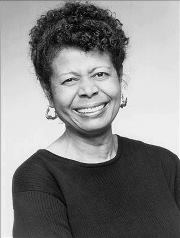 Jayne Cortez was born in Arizona, grew up in California, and currently lives in New York City and Dakar, Senegal. She is the author of ten books of poems and performer of her poetry with music on nine recordings. Her voice is celebrated for its political, surrealistic, dynamic innovations in lyricism, and visceral sound. Cortez has presented her work and ideas at universities, museums, and festivals in Africa, Asia, Europe, South America, the Caribbean and the United States. Her poems have been translated into many languages and widely published in anthologies, journals, and magazines. She is the recipient of several awards including: Arts International, the National Endowment for the Arts, the International African Festival Award, The Langston Hughes Award, and the American Book Award. Her most recent books are “The Beautiful Book” Bola Press 2007, “Jazz Fan Looks Back” published by Hanging Loose Press, and “Somewhere In Advance of Nowhere” published by Serpent’s Tail Ltd. Her latest CD recordings with the Firespitter Band are “Taking the Blues Back Home,” produced by Harmolodic and by Verve Records, “Borders of Disorderly Time” and “Find Your Own Voice” released by Bola Press. Cortez is director of the film “Yari Yari: Black Women Writers and the Future,” organizer of “Slave Routes the Long Memory” and “Yari Yari Pamberi: Black Women Writer Dissecting Globalization.” Both conferences were held at New York University. She is president of the Organization of Women Writers of Africa, Inc. and is on screen in the films: “Women In Jazz” and “Poetry In Motion.”
Hosted, Produced, and Engineered by Arts Producer Joyce Jones.
Editors note: Here at Suga’ in My Bowl, we already miss Jayne a lot. We saw her often at various events and feel fortunate to have known her and heard her perform live. We’ve heard that plans are underway for public tributes and will post them on the site and via our Facebook and Twitter streams when we get concrete dates for these.
Web Extras
Read Jayne’s obituaries at the New York Times and The Guardian.
Watch Jayne perform live with drummer (and son) Denardo Coleman
Sunday 11/18 show: Pharoah Sanders
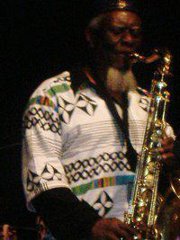 The next show will air on Sunday November 18, 2012 from 11:00pm – 1:00am Monday on WBAI, 99.5 FM in the NYC metro area or streaming online at wbai.org.
On Sunday, November 18, “Suga’ In My Bowl” will celebrate Jazz legend Pharoah Sanders’ run at Birdland this week by offering the program that originally aired on April 20, 2010. Join Joyce Jones and Hank Williams as they spend time with this marvel in the music.
Pharoah Sanders possesses one of the most distinctive tenor saxophone sounds in jazz. Harmonically rich and heavy with overtones, Sanders’ sound can be as raw and abrasive as it is possible for a saxophonist to produce. Yet, Sanders is highly regarded to the point of reverence by a great many jazz fans. Although he made his name with expressionistic, nearly anarchic free jazz in John Coltrane’s late ensembles of the mid-’60s, Sanders’ later music is guided by more graceful concerns.
The hallmarks of Sanders’ playing at that time were naked aggression and unrestrained passion. In the years after Coltrane’s death, however, Sanders explored other, somewhat gentler and perhaps more cerebral avenues — without, it should be added, sacrificing any of the intensity that defined his work as an apprentice to Coltrane.
Pharoah Sanders (his given name, Ferrell Sanders) was born into a musical family. Sanders’ first instrument was the clarinet, but he switched to tenor sax as a high school student, under the influence of his band director, Jimmy Cannon. Cannon also exposed Sanders to jazz for the first time. Sanders’ early favorites included Harold Land, James Moody, Sonny Rollins, Charlie Parker, and John Coltrane. As a teenager, he played blues gigs for ten and 15 dollars a night around Little Rock, backing such blues greats as Bobby “Blue” Bland and Junior Parker. After high school, Sanders moved to Oakland, CA, where he lived with relatives. He attended Oakland Junior College, studying art and music. Known in the San Francisco Bay Area as “Little Rock,” Sanders soon began playing bebop, rhythm & blues, and free jazz with many of the region’s finest musicians, including fellow saxophonists Dewey Redman and Sonny Simmons, as well as pianist Ed Kelly and drummer Smiley Winters. In 1961, Sanders moved to New York, where he struggled. Unable to make a living with his music, Sanders took to pawning his horn, working non-musical jobs, and sometimes sleeping on the subway. During this period he played with a number of free jazz luminaries, including Sun Ra, Don Cherry, and Billy Higgins. Sanders formed his first group in 1963, with pianist John Hicks (with whom he would continue to play off-and-on into the ’90s), bassist Wilbur Ware, and drummer Higgins. The group played an engagement at New York’s Village Gate. A member of the audience was John Coltrane, who apparently liked what he heard. In late 1964, Coltrane asked Sanders to sit in with his band. By the next year, Sanders was playing regularly with the Coltrane group, although he was never made an official member of the band. Coltrane’s ensembles with Sanders were some of the most controversial in the history of jazz. Their music, as represented by the group’s recordings — Om, Live at the Village Vanguard Again, and Live in Seattle among them — represents a near total desertion of traditional jazz concepts, like swing and functional harmony, in favor of a teeming, irregularly structured, organic mixture of sound for sound’s sake. Strength was a necessity in that band, and as Coltrane realized, Sanders had it in abundance.
Sanders made his first record as a leader in 1964 for the ESP label. After John Coltrane’s death in 1967, Sanders worked briefly with his widow, Alice Coltrane. From the late ’60s, he worked primarily as a leader of his own ensembles. From 1966-1971, Sanders released several albums on Impulse, including Tauhid (1966), Karma (1969), Black Unity (1971), and Thembi (1971). In the mid-’70s, Sanders recorded his most commercial effort, Love Will Find a Way (Arista, 1977); it turned out to be a brief detour. From the late ’70s until 1987, he recorded for the small independent label Theresa. From 1987, Sanders recorded for the Evidence and Timeless labels. The former bought Theresa records in 1991 and subsequently re-released Sanders’ output for that company. In 1995, Sanders made his first major-label album in many years, Message From Home (produced by Bill Laswell for Verve). The two followed that one up in 1999 with Save Our Children. In 2000, Sanders released Spirits — a multi-ethnic live suite with Hamid Drake and Adam Rudolph. In the decades after his first recordings with Coltrane, Sanders developed into a more well-rounded artist, capable of playing convincingly in a variety of contexts, from free to mainstream. Some of his best work is his most accessible. As a mature artist, Sanders discovered a hard-edged lyricism that has served him well.
Bio from Chris Kelsey, All Music Guide.
Show hosted and produced by Joyce Jones and Hank Williams. Engineered by Joyce Jones.
Next Show: Sunday 9/2 on Horace Tapscott/ Art and Black Los Angeles 1960-80
The next show will air on Sunday September 2, 2012 from 11:00pm – 1:00am Monday on WBAI, 99.5 FM in the NYC metro area or streaming online at wbai.org and feature exclusive interviews with author Steven Isoardi, author/ Professor/ curator Kellie Jones, and Multi-instrumentalist Sabir Mateen talking about the work of Horace Tapscott and Black art in Los Angeles. You can hear a short promo below:
 During this installment, we will feature “Now Dig This! Art and Black Los Angeles, 1960-1980” with the curator of the exhibit Dr. Kellie Jones, Associate Professor of Art History at Columbia University. We will also speak to Steven Isoardi, author of “The Dark Tree: Jazz and the Community Arts in Los Angeles” and multi-instrumentalist Sabir Mateen about pianist, composer and cultural activist Horace Tapscott.
Now Dig This! Art and Black Los Angeles 1960–1980 chronicles the vital legacy of the African American arts community in Los Angeles, examining a pioneering group of Black artists whose work and connections with other artists of varied ethnic backgrounds helped shape the creative output of Southern California. The exhibition presents approximately 140 works by thirty-two artists active during this historical period, exploring the rising strength of the Black community in Los Angeles as well as the increasing political, social, and economic power of African Americans across the nation.
On October 21, 2012, the exhibit will be on display at MoMA PS 1 in Long Island City through March 11, 2013.
Horace Elva Tapscott (b. Houston, 6 April 1934; d. Los Angeles, 27 Feb 1999) began piano studies at the age of six with his mother, the pianist Mary Lou Malone, and took up trombone two years later. His family moved to Los Angeles in 1943 and he studied trombone in school, playing with Frank Morgan in a high-school band; other young associates from this period included Don Cherry and Billy Higgins. Tapscott worked with Gerald Wilson’s orchestra before graduating from Jefferson High School in 1952. After studying briefly at Los Angeles City College he enlisted in the air force, and served in a band in Wyoming (1953-7). He then returned to Los Angeles and worked with various local bands before touring as a trombonist with Lionel Hampton (1959 to early 1961), for whom he also wrote a number of arrangements and at times sat in on piano. By the early 1960s he was playing piano exclusively, in part because of persistent dental problems resulting from an automobile accident during his high-school years.
By the end of 1961 Tapscott had formed the Pan Afrikan Peoples Arkestra, which at various times included Arthur Blythe, Stanley Crouch, Azar Lawrence, Marcus McLaurine, Roberto Miranda, the brothers Butch and Wilber Morris, David Murray, the saxophonist Michael Session, Sonship Theus, and Jimmy Woods. The purpose of the Arkestra was to preserve, develop, and perform African-American music within the community. Its rapid growth and branching off into related social and artistic activities led to the formation in 1963 of a larger organization, the Underground Musicians Association (UGMA), of which the Pan Afrikan Peoples Arkestra was a component. By the late 1960s the organization’s continued evolution led to broader community involvement, symbolized by a change of name to the Union of God’s Musicians and Artists Ascension (UGMAA). Although activities had tapered off by the mid-1980s, both the Arkestra and UGMAA continued to play a role in their community in the 1990s.
Horace Tapscott’s archives are now housed in University of California, Los Angeles (UCLA) Music Library.
Produced, hosted, and engineered by Arts Producer Joyce Jones
Art images courtesy of the Hammer Museum in Los Angeles, CA.
Web Extras
See more details on the documentary film about Black Los Angeles at the site of Leimert Park: The Story of a Village in South Central LA
Watch a short video preview of the “Now Dig This” show from its previous run at LA’s Hammer Museum. It shows some of the art.
See a few more photos discussed in this week’s Suga’ in My Bowl show:
Next show: Sunday, 6/17 with James Mtume on Miles Davis’s electric period
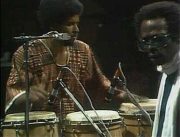 This installment will feature composer, producer and former percussionist with Miles Davis during his “electric period” James Mtume from 1971 to 1975. It will air on Sunday June 17, 2012 at 11:00pm – Monday at 1:00am on WBAI, 99.5 FM in the NYC metro area or streaming online at wbai.org. You can hear a 30-second promo below:
James Mtume was raised in a musical family where his father and uncles formed a band “The Heath Brothers”. Already in the sixties, James Mtume studied percussion and soon after this, he also acquired guitar playing skills. It didn’t take long before he played together with artists like Herbie Hancock, Joe Henderson, Freddie Hubbard and eventually became the percussionist for Miles Davis. In the Miles Davis band, Reggie Lucas played guitar, and it was with Reggie Lucas that James Mtume started a song writing partnership that became the R&B group Mtume.
Mtume recorded as a bandleader for Strata-East before turning to funk in the late ’70s. Mtume’s band included the sassy, sultry vocalist Tawatha Agee, keyboardist Phil Fields, and bassist Ray Johnson. Mtume, the band, had a number one R&B hit with “Juicy Fruit” for Epic Records in 1983 and a number 2 R&B single in 1984 with “You, Me and He”. Mtume recorded for Epic until the late ’80s. Their final Top Ten hit was “Breathless” in 1986. Mtume produced and/or wrote for such artists as Stephanie Mills, Roberta Flack/Donny Hathaway, Phyllis Hyman, Gary Bartz, Sadane, Lou Rawls, Rena Scott, Eddie Henderson in the late ’70s, Levert, Tyrone Brunson, Roy Ayers, Henderson and Tease. Roots and Influences: Miles Davis and Pharoah Sanders. Mtume’s hits for Robert Flack and Donny Hathaway include “The Closer I Get To You” and “Back Together Again”, both platinum sellers and widely viewed “classic songs” in the business.
Hosted by Joyce Jones.
Web extra: Watch this discussion between jazz critic Stanley Crouch and James Mtume on the music of Miles Davis’s electric period. If you have an older computer or slower internet connection, changing the video quality to a lower setting will give you smoother play with fewer interruptions. Youtube explains how to do that here.
Part 1: 14 minutes, 40 seconds
Part 2: 14 minutes, 9 seconds
 Suga' in My Bowl