Suga' in My Bowl
Pianists
Sunday 12/9 show: John Medeski
 The next show will air on Sunday December 9, 2012 from 11:00pm – 1:00am Monday on WBAI, 99.5 FM in the NYC metro area or streaming online at wbai.org. On this installment of “Suga’ In My Bowl,” we will present keyboardist, composer, “arti-vist” and one-third of the group Medeski Martin and Wood, John Medeski. Join in and help us “Reboot WBAI“!
As the keyboardist in the trailblazing instrumental trio Medeski Martin & Wood, solo performer, leader of his own project the Itch, film composer, and producer, collaborator and sideman with countless other artists, Medeski has channeled this transformative force with uncanny power and imagination.
A skilled composer and whirling-dervish improviser, he consistently wrings sonic revelations from acoustic and electric piano, Hammond organ, Clavinet, Mellotron, assorted synthesizers and other instruments. He’s nearly as dynamic visually as aurally, windmilling his hands across the keys, leaning into a B-3 stab, reaching inside the piano to tap the strings with a screwdriver.
Whether the music he’s playing at any given moment can be classified as jazz, funk, modern classical, avant-noise, roots music, rock or “world,” however, is of little concern. “I never separated music into categories,” he insists. “Whoever I’m playing with, I just think, ‘What can I add that will be part of this? Does it need anything?’”
He was born in Kentucky but raised in Florida, starting piano lessons at the tender age of five. Though his fervor for music wasn’t instantaneous, he had his first “out-of-body experience” playing a Mozart sonata while still an adolescent. “It was a competition, and I guess I arrived late, because I had no time to get ready and just sat down and played,” he recalls. “It was like I wasn’t even playing – I was just transported. After that, I did whatever I could to get that feeling back.”
Medeski sold his piano before leaving home to attend the New England Conservatory (NEC) in Boston. He continued to play piano there, but the discovery of a dust-covered Hammond B-3 organ in a rehearsal hall would significantly alter his course. “I’d checked out the B-3 before and listened to Jimmy Smith and Larry Young,” he notes, “but this time, when we started jamming with it, I was blown away. It was a universe of sound. I was playing a lot of free jazz at the time and really got into the coloristic possibilities of the instrument.”
A group that effortlessly straddles the gap between avant-garde improvisation and accessible groove-based jazz, Medeski, Martin & Wood have simultaneously earned standings as relentlessly innovative musicians and as an enormously popular act. Emerging out of the New York downtown scene in the early ’90s, MMW soon set out on endless cross-country tours before returning home to Manhattan to further refine their sound through myriad influential experimentations. Each of the musicians — keyboardist John Medeski, drummer/percussionist Billy Martin, and bassist Chris Wood — had crossed paths throughout the ’80s, playing with the likes of John Lurie, John Zorn, and Martin mentor Bob Moses. In 1991, the trio officially convened for an engagement at New York’s Village Gate. Soon, the group was rehearsing in Martin’s loft, writing, and then recording 1992’s self-released Notes from the Underground. As the group began to tour, escaping the supportive though insular New York music community, Medeski — a former child prodigy — switched to a Hammond B-3 organ rather than a grand piano.
WBAI is also in the middle of a short fund drive to help the station recover from time off the air during Hurricane Sandy. While we’re airing a regular show this time, If you haven’t pledged recently, please consider making a donation while we’re on the air. Copies of The Journey radio documentary with Bobby Sanabria that chronicles the trip of music from Africa to the Caribbean and Latin America are still available, as are copies of The Blues Journey with Dr. Guthrie Ramsey.
Produced by Joyce Jones and Hank Williams. Hosted and Engineered by Joyce Jones.
Sunday 11/4 show: Pianist Onaje Allen Gumbs
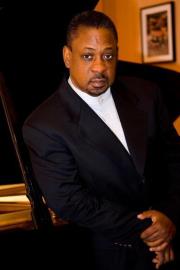 The next show will air on Sunday November 4, 2012 from 11:00pm – 1:00am Monday on WBAI, 99.5 FM in the NYC metro area or streaming online at wbai.org. WBAI’s stream may not be available due to to damage suffered in Hurricane Sandy. Because the station is operating from a remote location, the show may not start exactly at 11, so please be patient if you’re listening live. We’ve decided to make it available on our archives page at the normal air time to make it as available as possible.
During this post-Hurricane Sandy installment, we will feature pianist/keyboardist/producer/arranger/songwriter Onaje Allan Gumbs (pronounced Oh-Nah-Jay), who is one of the music industry’s most respected and talented music collaborators. Gumbs has worked almost three decades with top talent in the musical fields of jazz, R&B/soul, and pop to hone his considerable skills. A partial list includes Woody Shaw, Nat Adderly, Norman Connors, Angela Bofill, Jean Carn, Cassandra Wilson, Marlena Shaw, Sadao Watanabe, Phyllis Hyman (“The Answer Is You” from his 1979 Somewhere in My Lifetime album), Stanley Jordan, Denise Williams, Vanessa Rubin, Jeffrey Osborne, Eddie Murphy, Rebbie Jackson, and Gerald Albright (Live at Birdland West).
In 1974, Gumbs enjoyed one of the highlights of his arranging career when he created a special arrangement of “Stella By Starlight” for the New York Jazz Repertory Company as a part of a concert honoring Miles Davis at Carnegie Hall. That same year, Gumbs performed on (former Suga’ guest) Woody Shaw’s “Moon Moontrane”. Later, he joined forces with trumpeter Nat Adderley and his quintet, contributing to the group’s recordings on the Atlantic and Steeplechase record labels. Steeplechase’s Nils Winter was impressed by Gumbs’ solo improvisations on several of Adderley’s performances and approached the young pianist that same year to record a solo piano album, Onaje. In 1985, Gumbs further heightened his visibility by contributing his arrangement of “Lady in My Life” to guitarist Stanley Jordan’s enormously successful album Magic Touch. The record held the number one spot on Billboard‘s jazz charts for 37 weeks. The pianist recorded two albums for MCA: That Special Part of Me and 1991’s Dare to Dream.
Gumbs received an NAACP Image Award in 2006 in the Outstanding Jazz category for his independent project Remember Their Innocence.
Jazz Improv Magazine selected his Sack Full of Dreams album featuring singer, actor, producer, and director Obba Babatunde as one of the best jazz recordings of 2007.
Hosted, engineered, and produced by Arts Producer Joyce Jones
Next Show: Sunday 9/2 on Horace Tapscott/ Art and Black Los Angeles 1960-80
The next show will air on Sunday September 2, 2012 from 11:00pm – 1:00am Monday on WBAI, 99.5 FM in the NYC metro area or streaming online at wbai.org and feature exclusive interviews with author Steven Isoardi, author/ Professor/ curator Kellie Jones, and Multi-instrumentalist Sabir Mateen talking about the work of Horace Tapscott and Black art in Los Angeles. You can hear a short promo below:
 During this installment, we will feature “Now Dig This! Art and Black Los Angeles, 1960-1980” with the curator of the exhibit Dr. Kellie Jones, Associate Professor of Art History at Columbia University. We will also speak to Steven Isoardi, author of “The Dark Tree: Jazz and the Community Arts in Los Angeles” and multi-instrumentalist Sabir Mateen about pianist, composer and cultural activist Horace Tapscott.
Now Dig This! Art and Black Los Angeles 1960–1980 chronicles the vital legacy of the African American arts community in Los Angeles, examining a pioneering group of Black artists whose work and connections with other artists of varied ethnic backgrounds helped shape the creative output of Southern California. The exhibition presents approximately 140 works by thirty-two artists active during this historical period, exploring the rising strength of the Black community in Los Angeles as well as the increasing political, social, and economic power of African Americans across the nation.
On October 21, 2012, the exhibit will be on display at MoMA PS 1 in Long Island City through March 11, 2013.
Horace Elva Tapscott (b. Houston, 6 April 1934; d. Los Angeles, 27 Feb 1999) began piano studies at the age of six with his mother, the pianist Mary Lou Malone, and took up trombone two years later. His family moved to Los Angeles in 1943 and he studied trombone in school, playing with Frank Morgan in a high-school band; other young associates from this period included Don Cherry and Billy Higgins. Tapscott worked with Gerald Wilson’s orchestra before graduating from Jefferson High School in 1952. After studying briefly at Los Angeles City College he enlisted in the air force, and served in a band in Wyoming (1953-7). He then returned to Los Angeles and worked with various local bands before touring as a trombonist with Lionel Hampton (1959 to early 1961), for whom he also wrote a number of arrangements and at times sat in on piano. By the early 1960s he was playing piano exclusively, in part because of persistent dental problems resulting from an automobile accident during his high-school years.
By the end of 1961 Tapscott had formed the Pan Afrikan Peoples Arkestra, which at various times included Arthur Blythe, Stanley Crouch, Azar Lawrence, Marcus McLaurine, Roberto Miranda, the brothers Butch and Wilber Morris, David Murray, the saxophonist Michael Session, Sonship Theus, and Jimmy Woods. The purpose of the Arkestra was to preserve, develop, and perform African-American music within the community. Its rapid growth and branching off into related social and artistic activities led to the formation in 1963 of a larger organization, the Underground Musicians Association (UGMA), of which the Pan Afrikan Peoples Arkestra was a component. By the late 1960s the organization’s continued evolution led to broader community involvement, symbolized by a change of name to the Union of God’s Musicians and Artists Ascension (UGMAA). Although activities had tapered off by the mid-1980s, both the Arkestra and UGMAA continued to play a role in their community in the 1990s.
Horace Tapscott’s archives are now housed in University of California, Los Angeles (UCLA) Music Library.
Produced, hosted, and engineered by Arts Producer Joyce Jones
Art images courtesy of the Hammer Museum in Los Angeles, CA.
Web Extras
See more details on the documentary film about Black Los Angeles at the site of Leimert Park: The Story of a Village in South Central LA
Watch a short video preview of the “Now Dig This” show from its previous run at LA’s Hammer Museum. It shows some of the art.
See a few more photos discussed in this week’s Suga’ in My Bowl show:
 Suga' in My Bowl